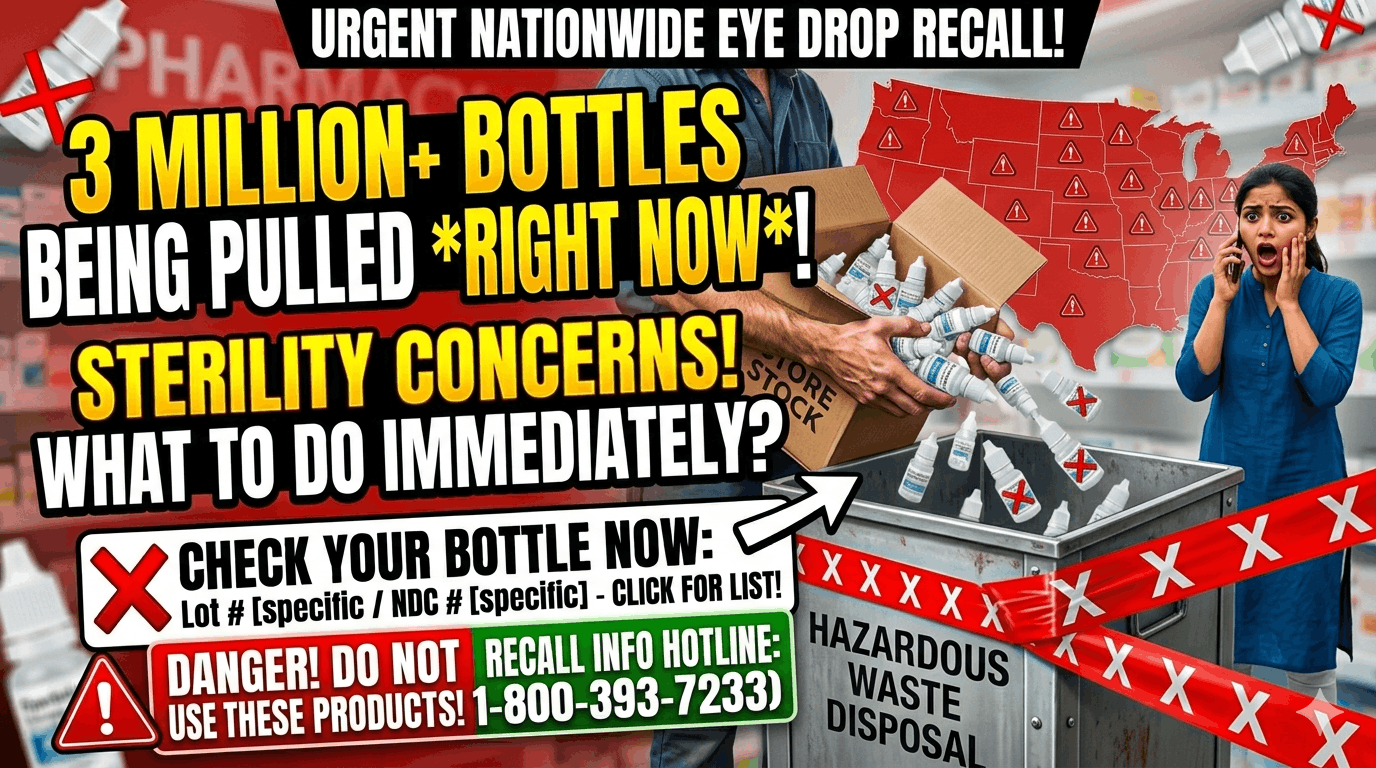
Over 3 million eye drop bottles recalled nationwide over sterility concerns. Check if your brand is on the list and what to do right now. Introduction: Check Your Medicine Cabinet Right Now
If you have a bottle of eye drops at home — artificial tears, redness relief, lubricating drops — there’s a real chance it’s part of one of the largest eye drop recalls in recent U.S. history.
On March 31, 2026, the U.S. Food and Drug Administration (FDA) disclosed that Pomona, California-based K.C. Pharmaceuticals, Inc. has voluntarily recalled over 3.1 million bottles of eye drops distributed nationwide. The recall spans 26 major labels sold at some of the most familiar stores in the country — Walgreens, CVS, Rite Aid, Kroger, Publix, H-E-B, Dollar General, and more.
The reason for this massive recall comes down to four words that should concern any consumer: “lack of assurance of sterility.”
This guide breaks down everything you need to know — what was recalled, which brands are affected, what the health risks actually are, how to check your bottles, and exactly what steps to take if you have one of the recalled products.
What Is the Eye Drop Recall About?
The Manufacturer and the Scale
K.C. Pharmaceuticals, Inc., based in Pomona, California, voluntarily recalled exactly 3,111,072 bottles of eye drops. The recall was initially initiated on March 3, 2026, and was formally classified and publicly disclosed by the FDA on March 31, 2026.
The scale of this recall is significant. Over three million bottles is not a minor batch correction — it represents a widespread distribution problem affecting products that were on store shelves across the entire country.
What “Lack of Assurance of Sterility” Actually Means
This is the phrase at the heart of the recall, and it’s important to understand exactly what it does — and doesn’t — mean.
The primary concern is a “Lack of Assurance of Sterility,” meaning the company cannot guarantee that the manufacturing process prevented the introduction of infection-causing microbes.
In plain English: something went wrong during production that means K.C. Pharmaceuticals cannot confirm these bottles are free from bacteria or other microorganisms. Eye drops go directly onto one of the most sensitive and infection-vulnerable parts of your body. The eye has almost no natural defense against contaminated liquids introduced directly onto its surface.
The FDA report did not explicitly state that any of the bottles were found to be contaminated, only that the safety standards required to ensure sterility were not met.
So while no confirmed contamination has been reported, the risk cannot be ruled out — which is precisely why the recall was issued.
How the FDA Classified This Recall
The agency assigned the recall the ranking of a “Class II” recall. A Class II recall refers to a situation in which use of or exposure to a violative product may cause temporary or medically reversible adverse health consequences, or where the probability of serious adverse health consequences is remote.
Class II is the middle tier of FDA recall classifications. It sits below a Class I recall, which covers products that could cause serious harm or death, and above Class III, which covers products unlikely to cause health problems. The Class II classification means the FDA considers the risk real but not immediately life-threatening.
Which Eye Drop Brands Are Affected?
The Retailers and Distributors Involved
The recall spans a wide variety of products, including “Artificial Tears,” “Advanced Relief,” and “Redness Lubricant” drops. Major retailers involved include pharmacy giants like CVS and Walgreens, grocery chains like Kroger and H-E-B, and distributors like Cardinal Health and McKesson.
The full list of store brands and retail locations where recalled products were sold includes:
Pharmacy Chains:
- Walgreens
- CVS Health
- Rite Aid
Supermarkets and Grocery Stores:
- Kroger
- H-E-B
- Publix
- Meijer
- Harris Teeter
Other Retailers and Distributors:
- Dollar General
- Circle K
- Cintas
- Military Exchanges
- Wholesale brands including Leader and Equaline
- Distributors Cardinal Health and McKesson
This list covers a broad swath of everyday shopping — from neighborhood pharmacies to grocery stores to military bases. If you’ve purchased store-brand eye drops from virtually any major national retailer in the past year, it’s worth checking.
Product Types in the Recall
The recall covers several different types of eye drops manufactured by K.C. Pharmaceuticals, sold under store-brand labels. The affected product categories include:
- Artificial Tears / Lubricating Eye Drops (polyethylene glycol formulas)
- Advanced Relief Eye Drops (multi-ingredient formulas)
- Redness Relief / Redness Lubricant Eye Drops (tetrahydrozoline-based)
- Sterile Eye Drops AC (tetrahydrozoline HCl + zinc sulfate)
- Ultra Lubricating Eye Drops (propylene glycol formulas)
- Allergy and Soothing Eye Drop variants
These are common, everyday products that millions of people keep in their homes, purses, and desk drawers. Many use them daily for dry eye, seasonal allergies, screen-related eye fatigue, or contact lens comfort.
How to Check If Your Eye Drops Are Recalled
Step-by-Step: What to Look For
Don’t assume your bottle is safe just because it looks fine. Here’s how to check in under two minutes:
- Pick up the bottle and look at the brand name on the label. If it’s a store brand from any of the retailers listed above (Walgreens, CVS, Kroger, etc.), proceed to step two.
- Find the lot code — this is usually printed on the bottom or side of the bottle, near the expiration date.
- Check the lot code prefix. Specifically look for codes starting with AC, AR, LT, SU, RG, RL, SY, or AT with 2026 expiration dates.
- Check the expiration date. Most affected lots have expiration dates extending into May or October 2026.
- Cross-reference with the FDA’s full enforcement report at FDA.gov for the complete list of lot codes and UPC numbers. The full report was published on March 31, 2026.
A Quick Lot Code Reference
Here’s a quick-reference guide for identifying recalled bottles:
| Lot Code Prefix | Example Lot Code | Expiration |
|---|---|---|
| AC | AC24E01 | 05/31/2026 |
| LT | LT24E01, LT24F01, LT24G01, LT24M01 | 05–10/2026 |
| AR | AR-series | 2026 |
| SU | SU-series | 2026 |
| RG / RL | RG/RL-series | 2026 |
| SY | SY-series | 2026 |
| AT | AT-series | 2026 |
If your bottle has any of these prefixes and a 2026 expiration date, stop using it immediately.
What Are the Health Risks?
Why Sterility Matters So Much for Eye Drops
The eye is one of the most infection-sensitive organs in the body. Unlike skin, which has multiple layers and natural bacterial defenses, the surface of the eye — the cornea and conjunctiva — is directly exposed to whatever you introduce with eye drops.
A contaminated eye drop solution applied directly to the eye can potentially cause:
- Bacterial eye infections (conjunctivitis or keratitis)
- Corneal ulcers in more serious cases
- Eye redness, pain, and discharge
- Temporary vision changes or blurring
- In severe or untreated cases, vision damage
What Symptoms Should Prompt Immediate Medical Attention?
Health officials recommend that anyone who has used these drops and experiences eye pain, redness, or vision changes should contact an eye doctor or healthcare provider immediately.
Specifically, seek care promptly if you notice any of the following after using recalled eye drops:
- Sudden or worsening eye pain
- Increased redness that doesn’t resolve
- Unusual discharge or crusting
- Blurred or altered vision
- Sensitivity to light
- A foreign body sensation that persists
These symptoms can indicate an infection developing. Eye infections, when caught early, are generally treatable. When left untreated, they can progress quickly and cause lasting damage.
What Should You Do If You Have Recalled Eye Drops?
Immediate Steps
Follow these steps right now if you believe you have one of the recalled products:
- Stop using the product immediately. Do not finish the bottle. Do not use it “just once more.”
- Do not share the bottle with anyone else or allow family members to use it.
- Set it aside — don’t throw it away yet if you want to return it for a refund.
- Check for symptoms. If you’ve already used the drops and have any eye discomfort, redness, or vision changes, call your eye doctor or visit an urgent care facility.
- Return the bottle to the retailer. While the FDA has not outlined a specific refund process, it is expected that major retailers may honor returns or exchanges for the identified lots. Bring the bottle with the lot code visible to your local pharmacy or store.
- Report the issue to the FDA. You can submit a voluntary report through the FDA’s MedWatch Safety Reporting Program at FDA.gov/safety/medwatch. Consumer reports help the FDA track patterns and potential harm.
For Ongoing Eye Drop Needs
If you rely on eye drops regularly for dry eye, allergies, or another condition, don’t simply go without. Talk to your pharmacist about alternative products not affected by this recall, or contact your eye doctor for a recommendation. Many nationally distributed name-brand artificial tears and lubricating drops were not part of this recall.
Practical Tips: How to Stay Safe With Eye Drops Going Forward
This recall is a good reminder that even everyday over-the-counter products carry risks when manufacturing standards aren’t upheld. Here are seven habits that protect your eye health when using any eye drops:
- Always check the lot number on any new eye drop bottle against the FDA’s current recall database at FDA.gov/safety/recalls-market-withdrawals-safety-alerts.
- Never share eye drops — even with family members. Sharing bottles transfers bacteria directly.
- Replace open bottles regularly. Most manufacturers recommend discarding open eye drop bottles after 28 to 30 days, even if product remains, because contamination risk rises over time.
- Avoid touching the dropper tip to your eye or any surface. This introduces microbes directly into the bottle.
- Store eye drops correctly. Keep them away from heat, humidity, and direct sunlight unless your product specifies otherwise.
- Check for cloudiness or particles. If the liquid looks discolored or you see floating particles, discard the bottle immediately.
- Sign up for FDA recall alerts at FDA.gov so future recalls reach you automatically by email.
A Pattern Worth Noting: Not the First Eye Drop Recall
This is not the first large-scale eye drop recall in recent years. The FDA has issued several eye drop-related recalls in the past two years alone, in some cases involving confirmed contamination with rare bacteria. Those recalls involved different manufacturers and products, but they underscore a broader concern: eye drops sold under store-brand or generic labels are produced by a relatively small number of contract manufacturers, and a problem at one factory can affect dozens of retail brands simultaneously.
That’s exactly what happened here. K.C. Pharmaceuticals produced eye drops sold under more than 26 different retail labels across the country. One manufacturer. One sterility concern. More than three million bottles.
Consumers who tend to reach for the store-brand option over name brands — often to save a few dollars — may want to pay extra attention to this dynamic going forward. Checking the manufacturer of your eye drops, not just the retail brand, is a meaningful step.
Conclusion: Your Eyesight Is Worth a Two-Minute Check
The recall of over 3 million eye drop bottles nationwide is a significant public health event, and it’s one that’s easy to act on quickly. You don’t need to panic, and you don’t need to assume the worst — but you do need to check.
Take two minutes right now. Find every bottle of eye drops in your home, check the brand, look at the lot code, confirm the expiration date. If it matches the recall criteria — stop using it, return it, and if you’ve had any symptoms, see a doctor.
Your action steps:
- ✅ Check your bottles against the recalled lot code prefixes (AC, AR, LT, SU, RG, RL, SY, AT) with 2026 expiration dates
- ✅ Stop use immediately if your product matches
- ✅ Return to the retailer for a refund or exchange
- ✅ See an eye doctor if you’ve experienced pain, redness, or vision changes
- ✅ Check the FDA’s full enforcement report at FDA.gov for complete lot codes and UPC numbers
- ✅ Sign up for FDA recall alerts to stay informed about future product safety issues
Share this article with family members and friends who use store-brand eye drops — especially those who use them daily for dry eye or allergies. The more people who see this recall information, the more eyes we protect.